The 15 Best Date Night Restaurants in Toronto
The Toronto restaurants that make a date feel shaped, warm, and worth remembering without leaning too hard on cliché.
The best date night restaurants in Toronto are Aloette Restaurant, Giulietta, Edulis Restaurant, and more. Start with Aloette Restaurant if you want the strongest overall first pick.
How we picked: We weight lighting, conversation volume, pacing, drinks, and whether the room can carry the night without forcing it.

Top picks at a glance
Practical notes
What to plan for before you book — spend, reservation strategy, and who should skip this guide entirely.
- Expected spend
- $$–$$$$ per person before drinks across these picks. Plan on $20–40 more per head if you're ordering a cocktail and a glass of wine.
- Booking strategy
- Reserve 7–14 days out for prime weekend windows. Weeknights are usually walk-in friendlier, especially in Toronto.
- What to order
- Skip the tasting menu unless the room is built for it — shared plates and one anchor dish tend to keep a date-night meal moving better than a marathon menu.
- Skip if
- you want pure value or a group plan. Date-night rooms are built for two-tops; bigger tables get a different recommendation.
Who this guide is for
Toronto offers plenty of strong places to eat, but date-night restaurants need more than good plates. These are the rooms where lighting, pace, and food all help the night hold together.
Quick picks
On this page
How the restaurants compare


How we chose
We looked for restaurants that feel like a strong fit for the guide topic, not just the most obvious names in the city. The shortlist favors rooms with clear mood, dependable pacing, and enough distinction to help someone decide faster. Read our full methodology →
Lighting, pace, and general energy all need to support the reason someone clicked this guide.
We favored restaurants that feel best suited for the moment, not just restaurants with broad reputation.
The final list tries to give readers enough variation in neighborhood, price, and style to compare real options.
6 ranked picks
Aloette occupies the ground floor of the same Queen Street West building as Alo, and that proximity is the point. Where Alo operates as one of Canada's most formally ambitious tasting-menu rooms, Aloette was designed from the start as its casual counterpart — a French-Canadian brasserie format that runs from morning through late evening and asks considerably less of your calendar and your patience. The concept is well-documented in Toronto dining circles as a deliberate exercise in accessible kitchen intelligence: the same culinary sensibility, applied to a room where you can realistically walk in on a Tuesday without a reservation three months prior.
The menu's reputation rests on its brasserie fundamentals executed with evident seriousness. The rotisserie chicken is consistently cited as a benchmark preparation — the kind of dish that signals a kitchen attending to stock and reduction rather than coasting on the rotisserie novelty. The smash burger has accumulated a genuine following, reportedly distinguished by correct American cheese melt and frites that hold their temperature, the markers of a kitchen that treats a burger as a technical exercise rather than an afterthought. The crème caramel is noted as a properly classical finish — set to order, caramel reportedly taken darker than Toronto's default, which is the correct decision. These are not showpiece dishes; they are the dishes that reveal whether a kitchen respects the fundamentals, and Aloette's reputation suggests it does.
The room itself is described consistently as warm and conversational — appropriate lighting, tables spaced for actual conversation, and a noise level that makes a two-hour lunch viable without effort. For anyone wanting the Alo team's standards without the tasting-menu commitment, weekday lunch walk-ins are reportedly feasible and represent one of downtown Toronto's more dependable spontaneous meals at this price point.
Rob Rossi's giulietta sits on Corso Italia, a stretch of Toronto that has its own Italian-American history, though the restaurant operates at a register well above the neighbourhood's red-sauce legacy. The room is consistently described as warm and considered — contemporary without veering into the kind of spare minimalism that drains occasion from a meal, and refined without the stiffness that makes guests conscious of their elbows. It reads, by most accounts, as a serious Italian restaurant that has decided not to cosplay as a trattoria, and that distinction matters in a city where the category can blur quickly.
Giulietta has built its reputation squarely on pasta, which in Toronto's current moment means something more demanding than house-made dough and Italian nomenclature. The restaurant operates in a city that has grown genuinely exacting about the form, and giulietta is routinely placed near the top of that conversation. The menu centres on housemade pasta, and the kitchen's approach is reported to reflect the kind of discipline — proper hydration, correct resting, sauces that coat rather than pool — that separates technically accomplished pasta from merely decent pasta. Beyond pasta, the menu draws on market-driven sourcing, with preparations that reportedly favour restraint over elaboration, trusting the ingredient rather than redirecting attention from it.
The wine list runs Italian and runs deep; staff are noted for navigating it with guests who lack regional fluency without the interaction becoming pedagogical, which is rarer than it should be at this price point. giulietta lands at price level three, and the case for that spend rests almost entirely on the pasta — if that is what you are coming for, the restaurant's reputation suggests the cheque is justified. Book ahead; the room is not large and the consistency of its following reflects accordingly.
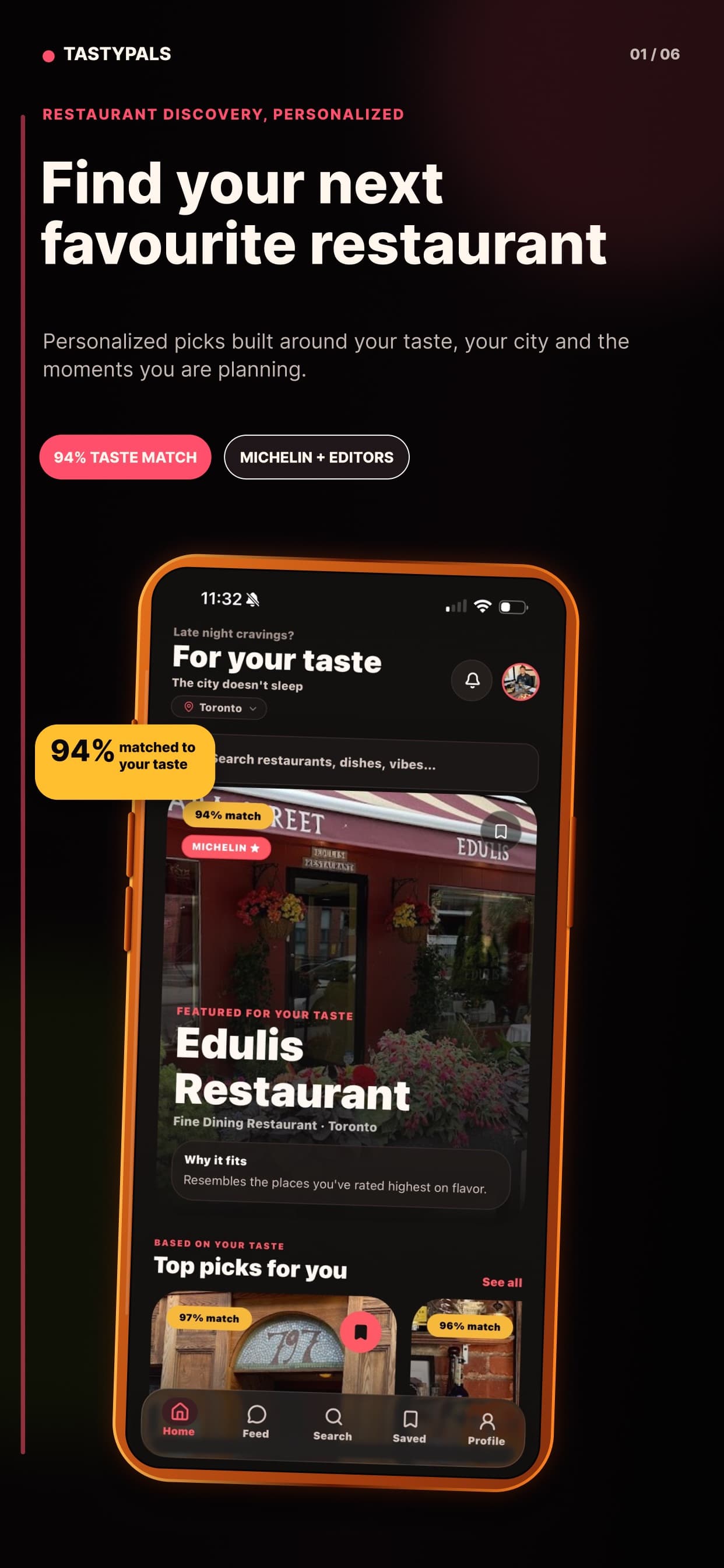
Michael Caballo and Tobey Nemeth's tasting menu room on Niagara Street has built a reputation as one of Canada's most considered fine dining propositions — not through the usual apparatus of luxury signalling, but through a foraged-ingredient philosophy that is reportedly an organizing principle rather than a concept cooked up for marketing. The kitchen's relationship with foraging, by all accounts, determines what gets cooked and when, making the menu genuinely contingent on what is actually ready rather than what the season is supposed to deliver. Diners and critics consistently note that fungi anchor much of the cooking — not because mushrooms are a trend the kitchen has adopted, but because years of working with foragers who understand exactly what Caballo and Nemeth require has apparently produced a depth of sourcing that most kitchens cannot replicate. The result, according to documented accounts, is a menu that changes continuously, not on a quarterly schedule but in response to what the land is producing at a given moment.
The room itself is small and, by most reports, quietly beautiful — intimate enough that the kitchen and dining room feel like parts of the same enterprise rather than separate operations. This scale appears deliberate: the cooking is personal, and the environment reportedly reflects that. Wild greens, foraged herbs, and fungi from established foraging relationships form the backbone of the tasting menu, which is the format the kitchen has chosen because no other structure would allow the same responsiveness to available ingredients.
Edulis takes reservations and books well ahead — plan accordingly and check availability early. This is a restaurant designed for diners with a genuine tolerance for the unfamiliar; those expecting a fixed luxury template are likely to find the experience disorienting rather than satisfying. Come with patience and an open brief.
Bar Isabel has been the anchor of Toronto's Spanish dining scene since Grant van Gameren opened it in Little Italy over a decade ago, and the restaurant's reputation has not softened with age — it has only sharpened. The kitchen's approach centers on the kind of unfussy, product-driven Spanish cooking that is harder to pull off than it looks: a commitment to doing familiar things correctly rather than inventively. The grilled octopus is among the dishes diners consistently point to, and the tortilla española has accumulated enough word-of-mouth to be considered by many the definitive version in Toronto — a dish that reportedly hits the technically tricky middle ground between set and yielding, which is where a tortilla either justifies the effort or doesn't. The house charcuterie is reportedly cured in-house, sliced to order, and served with accompaniments that contribute rather than just fill the board — a program serious enough to anchor a meal on its own.
The sherry-paired snacks are worth treating as an event rather than a preamble. Bar Isabel's approach to sherry as a pairing mechanism is one of the things that distinguishes it from restaurants that merely gesture at Spanish wine culture, and the broader list is known for being Spanish-focused and thoughtfully assembled, with staff equipped to guide guests through it at any level of familiarity with Iberian wine.
Practically: this is a loud room by design — communal tables built for groups, a bar that reportedly seats two comfortably for a longer evening. Price level puts it at the higher end of the Toronto casual-dining spectrum, so go with intention. Book ahead; this is not a walk-in-and-see situation on a weekend.
Dreyfus occupies a compact room in Harbord Village — a neighbourhood that sits adjacent to, but quieter than, Kensington Market — and has built a reputation consistent with that distinction: considered rather than showy, with a wine-bar sensibility that positions sharing plates and natural wine as a complete evening rather than a prelude to something else. The concept draws consistent comparisons to the Bar Isabel mode of casual-serious dining, though the register here is reportedly more relaxed, the room small and deliberately unhurried in a way that makes a two-hour Tuesday dinner feel entirely appropriate rather than indulgent.
The kitchen is known for leaning into seasonality, with a menu that rotates to reflect ingredient availability rather than anchoring itself to signature permanence. Because no specific dishes are currently verified, what can be said with confidence is that the approach — sharing plates composed around the kitchen's judgment rather than a guest's strategic ordering — is consistently cited as the point. Diners who order broadly and trust the room's logic apparently fare better than those attempting to engineer a composed meal from descriptions alone. That is, itself, an editorial position worth noting: it places confidence in the kitchen and asks the guest to follow.
The natural wine list is among the more purposeful in this part of the city, reputedly oriented toward small European producers without adopting a rigid orthodoxy about what natural means in practice. Staff knowledge of the list is frequently noted as a genuine asset — conversations about what to drink reportedly go somewhere useful rather than landing on a house recommendation and stopping there. Dreyfus takes reservations; for a weekend table, booking ahead is advisable. A practical point of entry: come with someone you are comfortable lingering with, because the room is designed for exactly that.
Prime Seafood Palace is a seafood omakase counter from the team behind Quetzal — Kate Chomyshyn, Julio Guajardo, and sommelier Remi Leroux — and its central premise is one that Toronto has not seen executed quite this way before: Japanese omakase discipline applied entirely to Canadian seafood sourcing. The result, by consistent account, is something genuinely singular. Where most omakase counters in the city default to imported Japanese product, this kitchen is reportedly built around relationships with Canadian suppliers who are selected specifically for what the kitchen's technique demands of them — a distinction that shapes the menu's character from the ground up.
The format itself is worth understanding before you book. Counter seats are the only configuration on offer, meaning the kitchen and the dining room occupy the same space. Diners consistently describe the experience as participatory in a way that a conventional tasting-room arrangement does not allow — courses arrive with the visible context of their assembly, and the omakase structure creates a natural framework for conversation between the kitchen and the counter. Because no verified dish list is publicly established, the menu should be understood as genuinely seasonal and responsive to supply, which is precisely the point the concept is making.
Practical considerations matter here. Reservations are reported to be competitive, and the window for booking should be treated accordingly — open the reservation system and move quickly. This is a counter built around seafood and around a specific kind of attentiveness to it, so a genuine interest in both the product and the conversation it generates is what the format rewards. Those expecting a passive tasting-menu experience may find the counter dynamic unfamiliar; those who engage with it are likely to find it among the more considered ways to spend an evening in Toronto's current dining landscape.
Explore next
Related guides
Guide • toronto
Best Brunch in Toronto
A sharper Toronto brunch shortlist built for weekends that want real appetite, useful room energy, and plans worth making.
Read guide
Guide • toronto
Best Restaurants in Toronto 2026
The definitive Toronto restaurant list — Alo at the top, Edulis close behind, and ten picks that span a 40-year institution, a wood-fire Mexican kitchen, a West African tasting menu, and the east end bistro everyone is suddenly talking about.
Read guide
Same guide in other cities
Get the App
Save these spots to your Toronto list
Save these spots to your Toronto list in the TastyPals app, then explore similar restaurants when you want a tighter shortlist for the night.