15 Best Fine Dining Restaurants in Austin
The best fine dining restaurants in Austin — Edge Rooftop, Dean's Italian Steakhouse, Ema - Austin, and Corinne at The Domain and 11 more, reviewed by TastyPals editors.
The best fine dining restaurants in Austin are Edge Rooftop, Dean's Italian Steakhouse, Ema - Austin, and more. Start with Edge Rooftop if you want the strongest overall first pick.
How we picked: We weight precision in the cooking, hospitality discipline, room tone, and whether the meal earns the cheque.

Top picks at a glance
Practical notes
What to plan for before you book — spend, reservation strategy, and who should skip this guide entirely.
- Expected spend
- $200–500+ per person. Tasting menus run 2.5–3.5 hours; wine pairings add $120–250.
- Booking strategy
- Reserve 14–30 days out for weekend windows. Many of these release tables at midnight 14 days ahead — set a calendar reminder.
- What to expect
- Slower pace, sommelier-led wine list, attention to room tone and service detail.
- Skip if
- you're trying to keep the night under 90 minutes or want a casual atmosphere. Fine dining here rewards the time investment.
Who this guide is for
The best fine dining restaurants in Austin earn their premium through precision, hospitality, and rooms that justify the occasion. These picks are sorted by rating and review depth. Picks span Austin, The Domain and South Lamar.
Quick picks
On this page
- 1. Edge RooftopView →
- 2. Dean's Italian SteakhouseView →
- 3. Ema - AustinView →
- 4. Corinne at The DomainView →
- 5. Fig Italian Kitchen & BarView →
- 6. ZanzibarView →
- 7. Ember KitchenView →
- 8. BOA SteakhouseView →
- 9. J-Prime SteakhouseView →
- 10. Uchiko AustinView →
- 11. Eddie V's Prime SeafoodView →
- 12. The Guest House AustinView →
- 13. Truluck's Ocean's Finest Seafood and CrabView →
- 14. Tatsumi SushiView →
How the restaurants compare


How we chose
We looked for restaurants that feel like a strong fit for the guide topic, not just the most obvious names in the city. The shortlist favors rooms with clear mood, dependable pacing, and enough distinction to help someone decide faster. Read our full methodology →
Lighting, pace, and general energy all need to support the reason someone clicked this guide.
We favored restaurants that feel best suited for the moment, not just restaurants with broad reputation.
The final list tries to give readers enough variation in neighborhood, price, and style to compare real options.
14 ranked picks
Let's be honest about what a hotel rooftop bar usually is: a place that charges you $18 for a view and a sad, wilting garnish. Edge, perched on the fifth floor of the JW Marriott on Congress, mostly dodges that fate — partly because the view (Town Lake to the Capitol, nearly 180 degrees of it) actually earns its keep, and partly because the kitchen bothers to show up. The brisket sliders are the move here, the kind of thing you order "just to share" and then quietly finish solo. Tuna tacos come out properly cooked rather than abused, and the JW chips-and-dip trio — guac, bean dip, roasted tomato salsa — is honest bar food that doesn't insult the room. Drinks run $15-$25, food hovers around $20, so this isn't a budget night, but the espresso martini is the one to spend on. The blue-and-purple underlit chairs lean a little 'nightclub in a SkyMall catalog,' but you're not here for the furniture. Come at sunset, skip the snow-machine holiday gimmicks, order sliders, and let the skyline do the heavy lifting.
Dean's Italian Steakhouse occupies a specific lane in Austin's dining landscape — the high-gloss, low-lit supper club that treats an evening out as theatre rather than transaction. The room is reportedly dim and velvet-draped, designed for lingering rather than turning tables quickly, and the concept wears its Italian-American influences without apology. This is not the austerity of a traditional chophouse; it is the kind of place where the cocktails and the soundtrack are understood to be part of the occasion, not incidental to it. Austin lacked this particular register for a long time, and Dean's has positioned itself as the room people turn to when the night calls for a degree of ceremony.
The menu centers on dry-aged beef as its anchor, with the dry-aged ribeye drawing consistent attention as the centerpiece order — a cut that the kitchen handles with the proper protocols that dry-aging demands. What distinguishes Dean's from a generic steakhouse is the Italian-American side of the ledger: the chicken parmesan is known as a substantial, shareable preparation rather than an afterthought, and the wedge salad holds its place as the kind of classic that belongs in a room like this. The martini, by all accounts, is treated seriously — a signal that the bar program is in conversation with the dining room rather than operating as a separate concern. The recommended approach, reflected across multiple accounts, is to build the table: a shared ribeye, the chicken parm alongside, and a wedge to anchor the early courses.
This is unambiguously a dressed-up, after-dark destination — the room is said to reach full effect once the evening crowd arrives. Reservations on weekends are reported to be essential, and the expectation should be a long table rather than a quick dinner. Book ahead, arrive at the bar, and plan accordingly.
Ēma sits inside the Domain's Northside sprawl, which is to say you arrive through parking structures and glass, then step into a room softened by trees and potted greenery — a Mediterranean daydream that mostly holds its shape against the mall around it. The lighting flatters, the pacing is unhurried, and there's enough air between tables that a second date can lower its voice without leaning in awkwardly. This is CJ Jacobson's lighter California cooking, mezze built for grazing and lingering, which suits a night meant to stretch. Start with the Sweet Corn Hummus and the Spicy Whipped Feta Spread ($16.95 each) — spreads reward sharing, and sharing reveals things about a person. The Octopus Carpaccio ($21.95) reads as the room's quiet flex; the Grilled Oishii Shrimp Kebab ($29.95) is the splurge that justifies dressing up. Small plates open at $13.95, so you control the tempo and the tab. It's genuinely a better date room than a Domain address has any right to be — go for dinner Friday, when the kitchen stays open till eleven and the night can wander.
Let's be honest about the setup: Corinne lives inside the Westin at The Domain, which usually spells beige hotel food and a bar that closes when the conference does. This one's better than it has any right to be. The move is brunch, where the homemade biscuits and butter do most of the persuading and the Tres Leches French Toast makes a strong case for skipping dinner entirely. The Crab Cake Benedict and Huevos Rancheros hold their own; the Wagyu Skillet and Grilled Chicken Tinga give the menu a little Austin swagger. At night, the Truffled Bucatini and Fried Bread Burrata are the ones people actually rave about — rich, unfussy, the kind of plates that reward a second cocktail. Value-wise, the $35 brunch (coffee, juice, one à la carte item) is fair, and the weekend 'Bubbles for a Buck' — a bottle of sparkling for a dollar with two entrees — is the sort of gimmick I'll happily be manipulated by. It's polished without being precious, service is genuinely warm, and the patio beats staring at your laptop upstairs. A smarter hotel restaurant than the address suggests.
Fig sits next to the Broken Spoke, which tells you everything about the collision South Lamar keeps making between old Austin and the Restoration Hardware version. The room leans hard into the latter — dark walls, black leather, gold accents, and those overhead lights The Infatuation rightly clocked as wavy potato chips. It photographs like a date night and largely behaves like one: the Chef's Table for two, angled at the pizza oven, is the move if you want your evening to have something to watch besides each other. Chef Cole Fitzgerald arrives with Michelin credentials (a 2023 Plate, a 'recommended' nod for Atlanta's White Bull), and his kitchen's instinct toward seasonality and Texas farms is genuine. The catch — and reviewers agree — is that the ambition sometimes over-dresses the plate. The pappardelle with lamb neck ragu is excellent until the fennel, raisins, and pistachios crowd it out. Order simply and you'll be happier: the truffle-butter brioche, the mushroom arancini, the tempura scallops. At $30–50 a head, it wants to be a destination. The room mostly earns it; the menu, on its quieter nights, catches up.
Let's be honest about what Zanzibar is: a tropical fever dream perched on the 7th floor of the Marriott downtown, all lush plants and skyline views, engineered so you forget you're in a hotel and start pretending you're on vacation. The cooking leans island-by-way-of-Asia, which sounds like a mess and mostly isn't. Order the duck egg rolls ($16) — rotisserie duck and cabbage with sweet chili, and yes, they earn the hype people keep giving them. The poke bowl does the ponzu-furikake-avocado thing competently, and the shrimp skewers ($21) come cilantro-marinated under a teriyaki glaze. There's a sushi burrito if you want to eat something ridiculous while overlooking Austin, plus a BCR Wagyu hand roll and pulled pork sliders with pineapple slaw for the table that can't commit. Is it overpriced? A little — small plates run $12–$22, and you're clearly paying the rooftop tax. But hit happy hour (Mon–Fri, 2–5) for $10 frozens and margaritas and the math softens considerably. Come for a sunset, not a serious dinner, and Zanzibar delivers exactly the escapist evening it's selling.
Let's get the sticker shock out of the way: Ember is not where you go to eat cheap. Mains climb well past what most Latin spots charge, and the seafood-and-steak end of the menu gets genuinely eye-watering. But there's a reason people shrug and hand over the card. The whole operation orbits a Josper — a coal-fired oven that's a rarity in this town — and it earns its keep. The Josper halibut comes with yellow tomato butter and rustic romesco, smoke doing the heavy lifting; the citrus-brined Josper chicken gets an achiote chimichurri that keeps things from turning polite. If you want the kitchen showing off, the salpicón de pulpo — escabeche octopus, salsa quemada, avocado mousse — is the move. Prime filet for the steak crowd. The room is the other draw: the old Seaholm Power Plant, all Art Deco brick and three-story glass over the boilers, multi-level and dramatic. Downstairs, Subterra pours agave spirits in the dark like it means it. Bring someone you're trying to impress, or your own expense account.
BOA Steakhouse occupies 8,000 square feet at 6th and Lavaca, and it wants you to know it. The 185-seat room trades in rift-cut oak, blackened steel, gray felt ceiling fixtures and tropical plants — dim, stylish, engineered for occasion. Chef James Flowers, formerly of the Four Seasons and Austin Proper, runs the kitchen, and the tableside Caesar is the room's theatrical calling card: prepared at your table, romance included.
The steaks justify the visit. The 40-day dry-aged New York strip ($65 for 12 oz, $72 for 16) is the house signature, backed by A5 Japanese Wagyu in Kagoshima, Iwate and Snow Beef varieties. Don't overlook the goat cheese baklava ($21), a dessert that oddly pairs pistachios, black truffle and frisee and somehow earns its place.
Expect north of $100 per head, with a Wine Spectator–recognized list and a strict dress code enforced at the door. This is a special-occasion room that knows it, and mostly delivers on the promise. Come for the aged strip and the Caesar; the room handles the rest.
J-Prime arrived downtown in August 2022, the Austin outpost of a San Antonio room that built its reputation on beef aged 45 to 60 days in-house. That figure matters more than the chandeliers and velvet, though the setting delivers what the occasion demands: golden light, oversized booths, seafood towers moving past on their way to celebrating tables at the corner of Brazos and San Jacinto.
The dry-aging is the argument here, and it pays off across the ribeye and New York strip. Start with the Wagyu black stone appetizer, which earns its melt-in-the-mouth billing, or the beef carpaccio. The surf and turf and lobster bisque are worth the commitment. Finish with Bananas Foster, flambeed tableside — theatrical, yes, but the homemade caramel is the real thing rather than mere spectacle.
This is a four-dollar-sign room, and it knows it. What justifies the cheque is the beef program and the tableside care, not the nightlife gloss layered over it. Come for an anniversary, order the steak you came for, and let the room do its work.
Tyson Cole built Uchi into one of Austin's most talked-about restaurants, then opened Uchiko as a deliberate extension of that project rather than a sequel to it. Where Uchi stakes its identity on a fairly classical Japanese foundation, Uchiko is organized around a specific creative argument: that Japanese culinary technique and Texas ingredient sourcing are not merely compatible but can produce something neither tradition would arrive at independently. Cole has spent enough years refining that argument that the synthesis, by most accounts, now feels inevitable rather than constructed — which is harder to pull off than it sounds.
The menu changes with some regularity, but a few preparations have accumulated the kind of consistent reputation that makes them reliable anchors when navigating a kitchen this ambitious. The farm egg with bacon dashi is the dish most Austin regulars cite first — a preparation that replaces the conventional kombu-and-katsuobushi base with bacon, reportedly producing a broth that reads as entirely Japanese in logic and entirely Texan in flavor. The daily nigiri is built around local sourcing relationships that, according to those who follow the restaurant closely, reflect real investment in what Austin's fishmongers can produce when a kitchen creates consistent demand for quality. The hama chili — yellowtail sashimi with jalapeño — has been widely imitated across Austin and is generally treated as the clearest single expression of what Uchiko is doing conceptually. That kind of imitation is worth noting; it suggests a dish that solved something.
Uchiko operates at price level four, which makes it a considered occasion rather than a casual weeknight decision. Reservations are strongly advised; the restaurant draws a loyal local following alongside destination diners, and walk-in availability is limited. Book ahead, and arrive with some flexibility for what the kitchen is emphasizing that evening.
There's a particular pride in dining at the original. Eddie V's launched here on East 5th Street in 2000, before Darden bought the name in 2011 and franchised the concept across the country. The room knows what it is: sultry earth tones, mixed wood finishes, occasional bursts of bold artwork, and a V Lounge where a live blues or jazz set softens the formality. It's built for the anniversary, the closed deal, the romance that needs a soundtrack. The kitchen leans on classics that justify the room. The Chilean sea bass is the house signature — buttery, restrained. Georges Bank scallops arrive sautéed with citrus and almonds, and the shellfish tower (shrimp, oysters, lump crab, lobster) is the centerpiece order for a table that wants to linger. The wine list is the genuine flex: 300-plus bottles, Wine Spectator-recognized, overseen by an Advanced Sommelier. At the top price tier, the occasion has to earn it — and a special night here largely does, provided you treat the room and the cellar as the point.
The Guest House Austin is an easy yes when you want somewhere that feels considered rather than fussy. It also holds a 9.4 rating across 2,424 Google reviews.
Truluck's on Colorado Street has been doing this, and it shows in the unhurried way the room carries an evening. There's a main dining room, an upstairs bar, and a second-deck terrace that hands you the skyline—worth requesting if you're trying to make a night feel like an occasion rather than a transaction. This is a white-tablecloth seafood house with prices to match (entrées land $40–46, and a full dinner runs $50–100 before you've touched the wine list, which has earned Wine Spectator's Award of Excellence). For the Florida stone crab, come October through May; it arrives chilled with mustard sauce, trap-to-table inside a day. The Miso-Glazed Sea Bass ($46) and Sesame Seared Tuna are the dishes people return for. If the math feels steep, the nightly 4:30–6 happy hour—half off cocktails, oysters, wines by the glass—is the smart way in, or the $59 TRU Ninety-Two prix fixe. A room built for slow conversation and someone you'd like to keep across the table.
Tatsumi has quietly become the kind of sushi bar Austin needed: serious about fish, generous with hospitality, and priced so you can actually make it a habit. The room centers on the bar—sleek and intimate without the hushed formality of the omakase-only circuit, which is exactly why it works for a Tuesday dinner as easily as a date night. Gary's Roll ($19) is the crowd favorite for good reason, stacking crab salad, king salmon, hamachi, and avocado into something that reads richer than its price. The Spider Roll ($20) delivers the crunch, but I'd steer you toward the raw fish, where this kitchen shows its hand. Ambitious eaters should chase the A5 Ebi Uni Maguro ($35), a charred Miyazaki-beef-and-uni maki capped at ten per evening. The Tatsumi Chirashi ($45) is the composed move for one clean, satisfying bowl. Small touches—a house-made soy sauce among them—signal a place that cares about the details most rooms outsource. Closed Mondays; go midweek when the bar seats feel like a conversation, not a reservation.
Explore next
Related guides

Guide • austin
14 Michelin-Recognized Restaurants in Austin
14 Michelin Guide restaurants in Austin — from starred destinations to Bib Gourmand and selected picks.
Read guide

Guide • austin
Best Restaurants in Austin 2026
The ten Austin restaurants that define the city's culinary moment — from Tyson Cole's Japanese-Texan temple and a live-fire downtown showpiece to a Caribbean East Austin phenomenon, the best biscuits in America, and a natural wine bar that rivals anything in the country.
Read guide
Guide • toronto
The 15 Best Date Night Restaurants in Toronto
The Toronto restaurants that make a date feel shaped, warm, and worth remembering without leaning too hard on cliché.
Read guide
Same guide in other cities
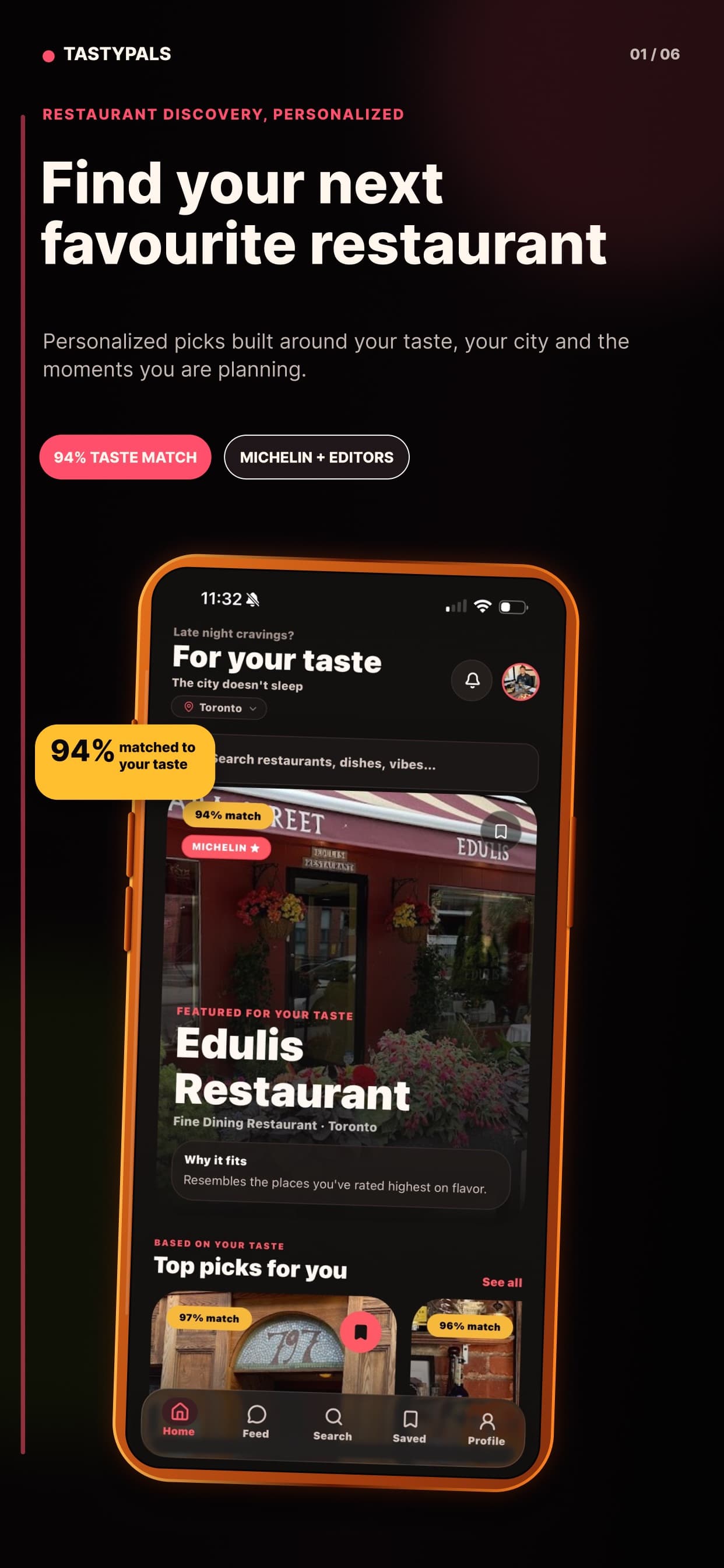
Get the App
Save these spots to your Austin list
Save these spots to your Austin list in the TastyPals app, then explore similar restaurants when you want a tighter shortlist for the night.